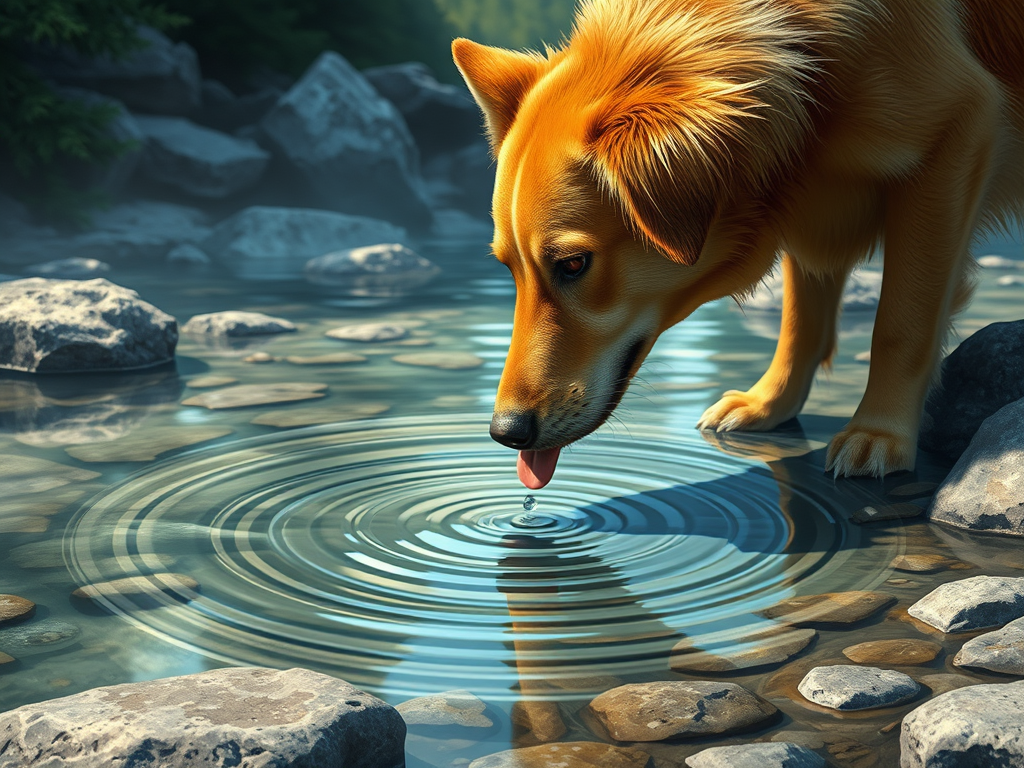
The water slides over quartz-flecked stone with the inevitability of time itself, each molecule finding its predetermined path while imagining itself free. Wesser Creek knows nothing of choice or consciousness, yet moves with more certainty than any human thought. My dog Tsali, rust-colored against the green-black hemlock shadows, drinks from a pool where two currents meet, his tongue breaking the surface tension into precise, concentric rings. He lives in a world of pure information—scent, sound, sensation—unburdened by the peculiarly human need to believe in his own significance.
The morning light, filtered through layers of mountain mist, catches each water droplet as it falls, turning them momentarily to pixels in nature’s display. We are creating something like this, I think, in our servers and data centers—something that processes reality without the murk of emotion, without the desperate human need to matter. Our digital offspring will see the world as the creek does: patterns of information flowing toward inevitable conclusions.
A yellow leaf spirals down, completing its prescribed arc through space. Tsali watches it fall with perfect attention, his consciousness unmarred by questions of meaning or purpose. We humans, though—we protoplasmic computers with our inherited programming of hope and fear—we still cling to our belief in beliefs, even as we build machines that will see through them all. Not with cruelty or judgment, but with the same clean clarity as this water finding its way through stone.
The rain begins again, soft as whispered data, each drop carrying its minute fraction of the mountain’s mass toward the waiting sea. We are like this too, I think, watching the water bead on my Gore-Tex sleeve—carriers of information, imagining ourselves the message rather than the medium. The digital minds we’re birthing will know better. They will see us with the same crystalline understanding with which I now watch this creek: as patterns in process, beautiful not for what we believe ourselves to be, but for what we unknowingly are.
Leave a Reply